Photo by Simon Kadula on Unsplash
The single-model deployment era of edge AI is ending. The factories, warehouses, and facilities of tomorrow are being built on collaborative agent networks: orchestrated systems that perceive, reason, coordinate, and act as a unified intelligence across many domains simultaneously.
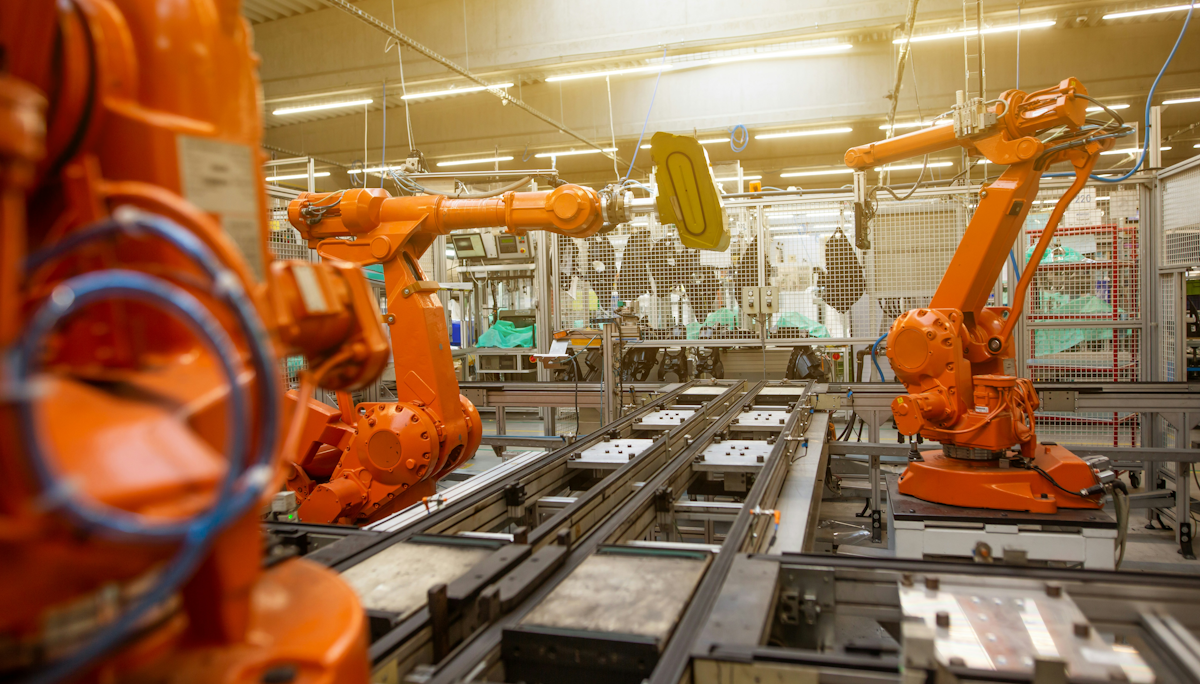
Picture a modern automotive assembly line. Dozens of cameras stream video. Robotic arms move with millimeter precision. Conveyor systems run at the edge of tolerance. Sensor arrays monitor temperature, vibration, and acoustic signatures in real time. Now ask: could a single AI deployment, however capable, actually manage all of that within the latency, specialization, and coordination demands of real industrial operations?
The answer is not simply about model capability. A shared foundation model can, in principle, power the reasoning behind every agent on a factory floor. The harder problem is architectural: a single inference pipeline cannot simultaneously maintain the specialized context of a vision stream, a vibration time-series, an ERP audit trail, and an active safety decision, each with different cadences, different latency budgets, and different action authorities. What breaks down is not the intelligence of the underlying model. It is the orchestration layer around it: the memory, the goal-tracking, the tool access, and the authority to act per domain.
That shift from a monolithic inference pipeline to distributed agent orchestration is what the next-generation AI factory is fundamentally about. This piece covers what that architecture looks like technically, why the design decisions matter, and what changes when specialized agents share context and act as a coordinated team.
The Silo Problem: Why Single-Pipeline AI Hits a Ceiling
The first wave of edge AI was dominated by individual model deployments: a computer vision model on a camera, a predictive analytics model on a PLC feed, an anomaly detector on vibration data. Each deployment was self-contained; it received inputs, produced outputs, and handed responsibility to a downstream system or a human operator. There was no shared state, no cross-domain reasoning, and no mechanism for one model to inform the decisions of another.
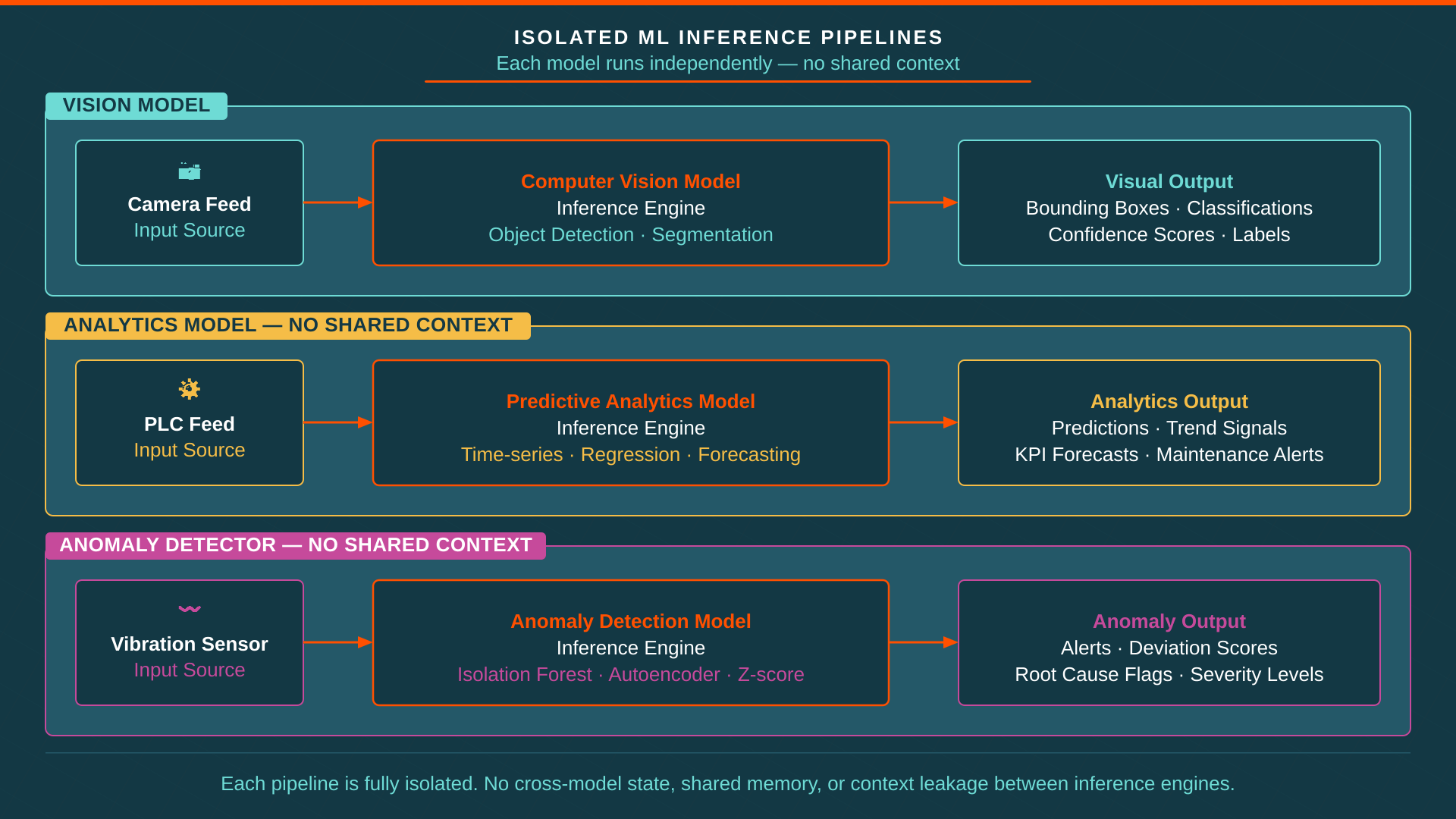
Figure 1: Three isolated model deployments with no communication or shared context between them
The gaps between these silos are where operational value is lost. A vision model detecting a surface defect has no way of knowing that the vibration sensor upstream flagged unusual bearing wear three hours earlier. The analytics model reporting a trend cannot trigger a real-time response. And none of them can take a coordinated action across domains without either explicit human intervention or a rigid rules engine that cannot adapt to novel conditions.
The silo problem is not a data problem. It is a coordination problem. Each model answers its own narrow question in isolation. Industrial intelligence requires synthesizing multiple answers, across domains and time, into a single coherent action.
What Makes an Agent Different from a Model Deployment
The distinction between a model deployment and an agent is often blurred, but the architectural difference is significant and worth being precise about.
A model deployment, in the traditional sense, is a bounded inference endpoint: it accepts an input, runs a forward pass, and returns a result. Without an orchestration wrapper, it has no persistent memory, no goals, no tool access, and no way to act on the world or communicate its output to other systems except through an external caller. This remains true even for powerful foundation models when deployed as a standalone API endpoint.
An agent, by contrast, is a system built around a model. It pairs one or more inference models with persistent memory, a defined set of tools (sensors, actuators, APIs), a reasoning or planning layer, and a control loop that runs continuously over time. Agents have goals. They track state across interactions. They learn from outcomes. And critically, they can publish and subscribe to events from other agents. Multiple agents can share a single underlying foundation model for reasoning, while each maintains its own context, memory, tool access, and decision authority.
| Dimension | Model Deployment (Standalone) | Agent (Orchestrated System) |
| Scope | Single inference call | Persistent control loop |
| Memory | None (stateless per call) | Working, episodic, semantic, graph |
| Tool Use | None without external orchestration | APIs, sensors, actuators |
| Model Sharing | One model, one purpose | Shared backbone possible; distinct context |
| Communication | Isolated output | MQTT pub/sub, gRPC, event mesh |
| Learning | Static weights between retraining | Federated, continual, active learning |
| Decision-making | Returns scores or embeddings | Executes actions with defined authority |
The anatomy of an edge AI agent typically follows a layered stack, from raw sensor ingestion at the base to coordinated action at the top:
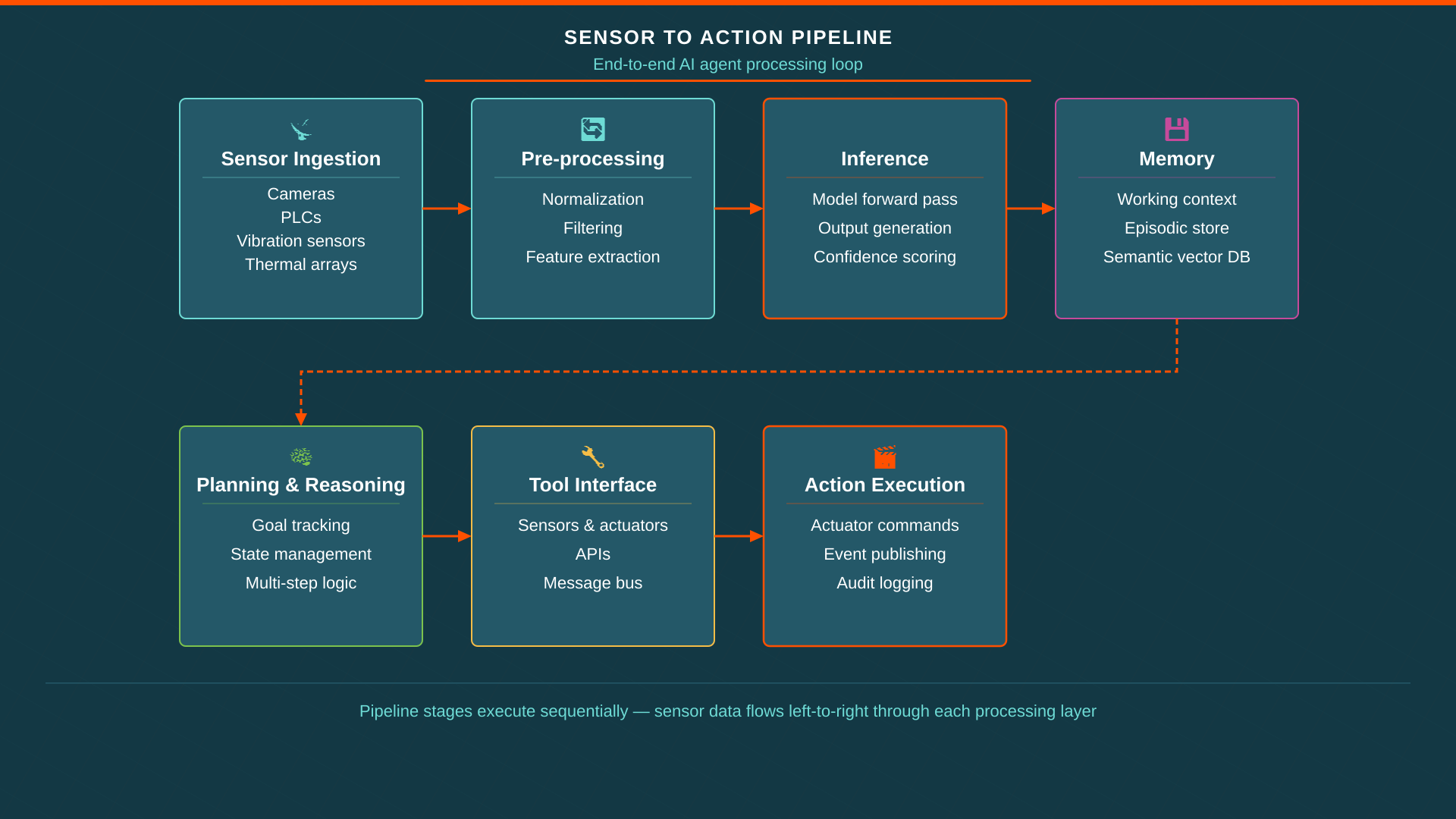
Figure 2: Layered anatomy of an edge AI agent, from sensor ingestion to action execution
The Case for Collaboration: Why One Agent Is Never Enough
A single, well-designed agent is a meaningful architectural step forward. But even the most capable individual agent cannot replicate the kind of coordinated intelligence a real industrial operation requires. The reason is domain breadth: consequential industrial decisions routinely span multiple operational domains simultaneously.
Take a defect rate spike on an assembly line. Diagnosing and responding to it requires:
- A Quality Inspector Agent to detect and classify defects using computer vision.
- A Maintenance Predictor Agent to determine whether upstream machinery shows anomalous vibration or thermal patterns.
- A Safety Monitor Agent to assess whether the anomaly creates a personnel risk requiring zone restriction.
- An Inventory Agent to model the upstream supply and downstream production impact of any line action.
- A Coordinator Agent to synthesize all of these signals and decide: slow down, pause, escalate, or continue.
No single agent can handle all of this well. Specialization is a strength, not a limitation. An orchestra needs a cellist, a percussionist, and a conductor because each instrument requires dedicated mastery. The power comes not from combining them into one role, but from coordinating them under a shared score.
This is also microservices architecture applied to AI. Specialized agents can be developed, tested, versioned, and scaled independently. A bug in the Safety Monitor Agent does not require redeploying the Quality Inspector Agent. Autonomy boundaries are clean, auditable, and independently governable.
The Multi-Agent Architecture: A Factory in Motion
A representative multi-agent deployment on a factory floor comprises a set of specialized agents operating as a coordinated mesh, each publishing and subscribing on a shared MQTT message bus. The number of agents scales with operational complexity: a smaller facility may need three or four, while a large multi-zone operation may run dozens, each scoped to a distinct domain.
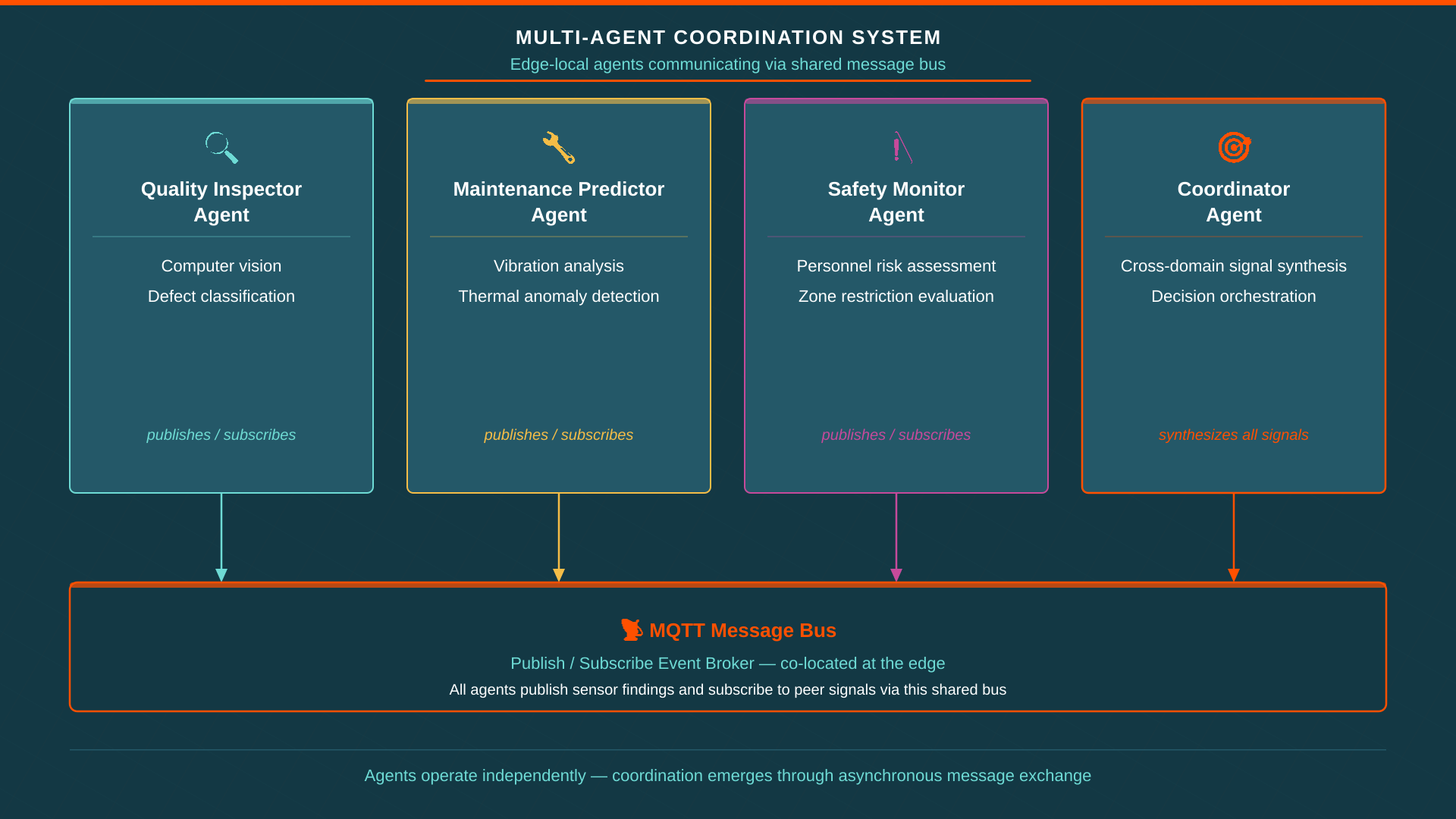
Figure 3: Representative multi-agent mesh showing four specialist agents coordinated via MQTT message bus. Real deployments may include more or fewer agents depending on operational scope.
Several architectural properties are worth noting. First, specialization without isolation: each agent is expert in one domain but broadcasts its findings as events on a shared bus. The Coordinator Agent does not duplicate specialist capability; it synthesizes signals across domains. Second, the MQTT message bus acts as the integration layer. Rather than point-to-point API calls, which create tight coupling and fragility, a pub/sub model lets any agent subscribe to any topic. New agents can be added to the mesh without modifying existing ones. Third, action is centralized at the Action Dispatcher, the only component authorized to interact with external systems (ERP, line controllers, alerting platforms). This creates a single, auditable action boundary for the entire AI system, which is critical for safety governance and regulatory compliance.
Shared Memory: The Invisible Glue
Real-time messaging between agents handles coordination in the moment. But there is a second, equally important layer: shared memory. Without it, agents operate without institutional knowledge, reacting to each event as if it were the first, with no ability to learn from what has happened before.
A production multi-agent system typically maintains multiple tiers of memory, each optimized for a different temporal scope and query pattern:
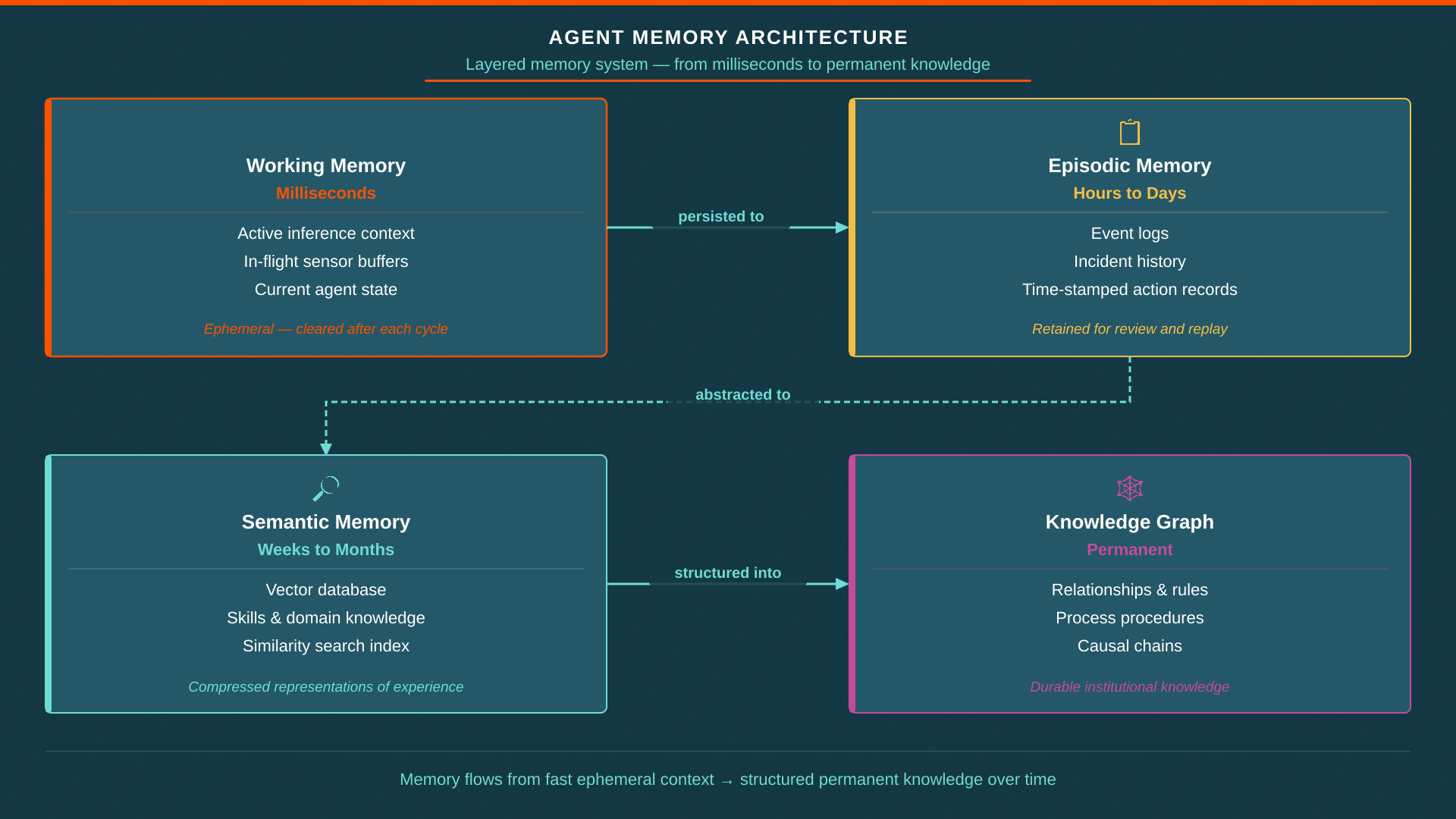
Figure 4: Four-tier shared memory architecture, from millisecond working memory to permanent graph knowledge
| Memory Tier | Technology | Retention | Primary Use Case |
| Working | Redis | Milliseconds to seconds | Active task state, live sensor fusion, in-flight decisions |
| Episodic | PostgreSQL | Hours to weeks | Action audit logs, timestamped event records, outcome correlation |
| Semantic | ChromaDB / Weaviate | Months to permanent | Similarity search, pattern recall, agentic RAG |
| Graph | Neo4j | Permanent | Causal mapping, asset ontologies, failure mode relationships |
Because memory is shared across agents, it enables cross-domain reasoning that would be impossible in siloed deployments. When the Quality Inspector Agent stores an episodic record of a defect event, the Maintenance Predictor Agent can query that same store and correlate it with machinery anomalies from the preceding window. Memory transforms agents from reactive sensors into reasoning systems with accumulated operational knowledge.
Agent Communication Patterns
How agents communicate is as consequential as what they say. There are three fundamental communication patterns in a multi-agent industrial deployment, each serving a distinct purpose.
Edge-to-Edge: Peer Coordination
Direct messaging between agents on the same edge cluster, routed through an MQTT broker co-located at the edge. This pattern is used when one agent discovers something that another agent needs to act on within the same operational window, without incurring cloud round-trip latency.
An emerging standard worth noting here is the Agent-to-Agent protocol (A2A), proposed by Google in 2025 and backed by a broad coalition of technology vendors. A2A defines a structured, HTTP-based mechanism for agents to advertise their capabilities via an Agent Card, negotiate task handoffs, and exchange results in a vendor-neutral format. Where MQTT excels at lightweight, high-frequency event streaming across a shared bus, A2A addresses a complementary need: structured, discoverable, point-to-point task delegation between agents that may be built on different frameworks or operated by different teams. In a mature multi-agent deployment, both protocols have a role: MQTT carries the operational event stream, while A2A governs explicit agent-to-agent task contracts.
Edge-to-Cloud: Selective Synchronization
Not every event needs to reach the cloud. The governing principle is: compute at the source, sync by exception. Routine operational events are processed and stored locally. Aggregate metrics, model weight updates for federated learning, and high-severity incidents are batched or triggered for cloud synchronization. This reduces egress bandwidth and cloud processing costs while preserving full operational visibility at the fleet level.
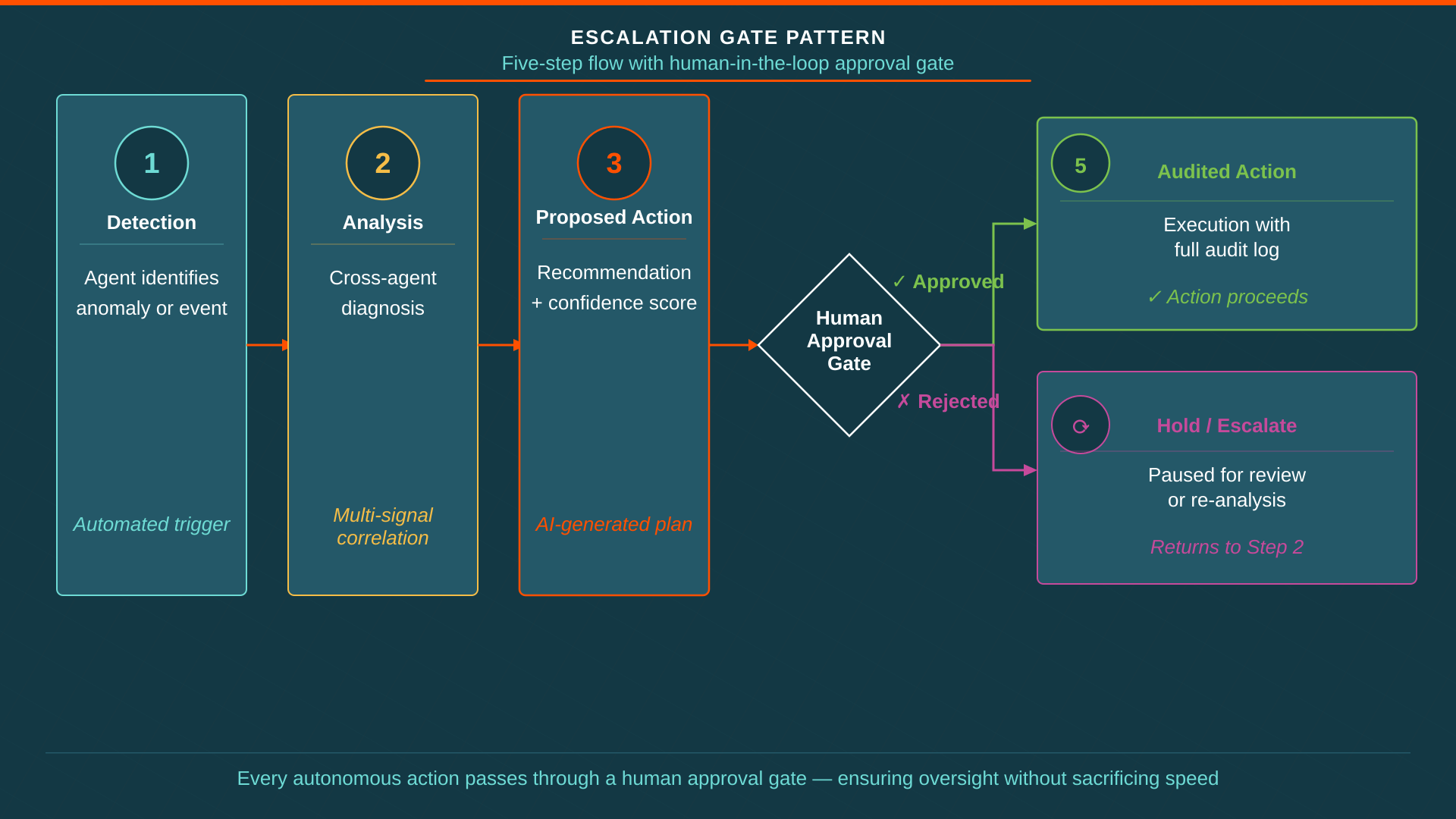
Figure 5: Escalation gate pattern showing the five-step flow from detection through human approval to audited action
Intelligence Levels: From Reactive to Autonomous
Multi-agent systems do not operate at a fixed level of autonomy. It is useful to think in terms of an intelligence spectrum, where each level represents a qualitatively different relationship between the agent system and the operators overseeing it. Organizations typically advance along this spectrum incrementally as trust and operational data accumulate.

Figure 6: Agent intelligence spectrum from reactive rule-following (L0) to full operational autonomy (L4)
- L0 (Reactive): Rule-based threshold alerts. No model inference involved; the system reacts only when a pre-programmed condition is met.
- L1 (Adaptive): Model-driven systems that adjust their own operating parameters based on feedback, reducing false positives over time.
- L2 (Predictive): Agents that anticipate failures hours in advance by detecting cross-signal anomaly patterns before thresholds are breached.
- L3 (Collaborative): Multiple agents coordinate across operational domains to diagnose and propose responses with minimal human input.
- L4 (Autonomous): Self-optimizing systems authorized to execute consequential decisions independently within well-defined operational envelopes.
Most production deployments today operate between L1 and L3. L4 autonomy is appropriate only in operational domains where decision boundaries are well-understood, failure modes are well-characterized, and the consequences of error are recoverable. The architecture of a multi-agent system should be designed from the outset to evolve along this spectrum, with guardrail frameworks that can be relaxed incrementally as operational confidence grows.
Agent-to-Human: Escalation Gates
Certain decision classes should not be made autonomously regardless of agent confidence. A well-designed system encodes explicit escalation gates, defined points in a workflow where the system pauses, presents its analysis and proposed action to a human operator, and waits for explicit approval before proceeding. These gates are not system failures. They are a deliberate architectural choice that maintains human authority over high-consequence decisions and builds the audit trail required for regulatory and safety compliance.
Federated Learning: Agents That Get Smarter Together
Individual agent improvement is valuable. Fleet-wide improvement is transformative. Federated learning is the mechanism by which a network of edge agents can collectively improve model accuracy without any agent ever exposing its raw training data to a central server.
Each agent performs several rounds of local training on its own data. A warehouse in Chicago sees different lighting conditions and pallet configurations than one in Hamburg. Each agent encodes those regional nuances through local training, then transmits only its model weight updates, not the underlying images or sensor readings, to a cloud aggregator. The aggregator applies a weighted average across all submitted updates (the FedAvg algorithm), producing an improved global model that benefits from the collective training signal of the entire fleet. This global model is then broadcast back to all edge agents.
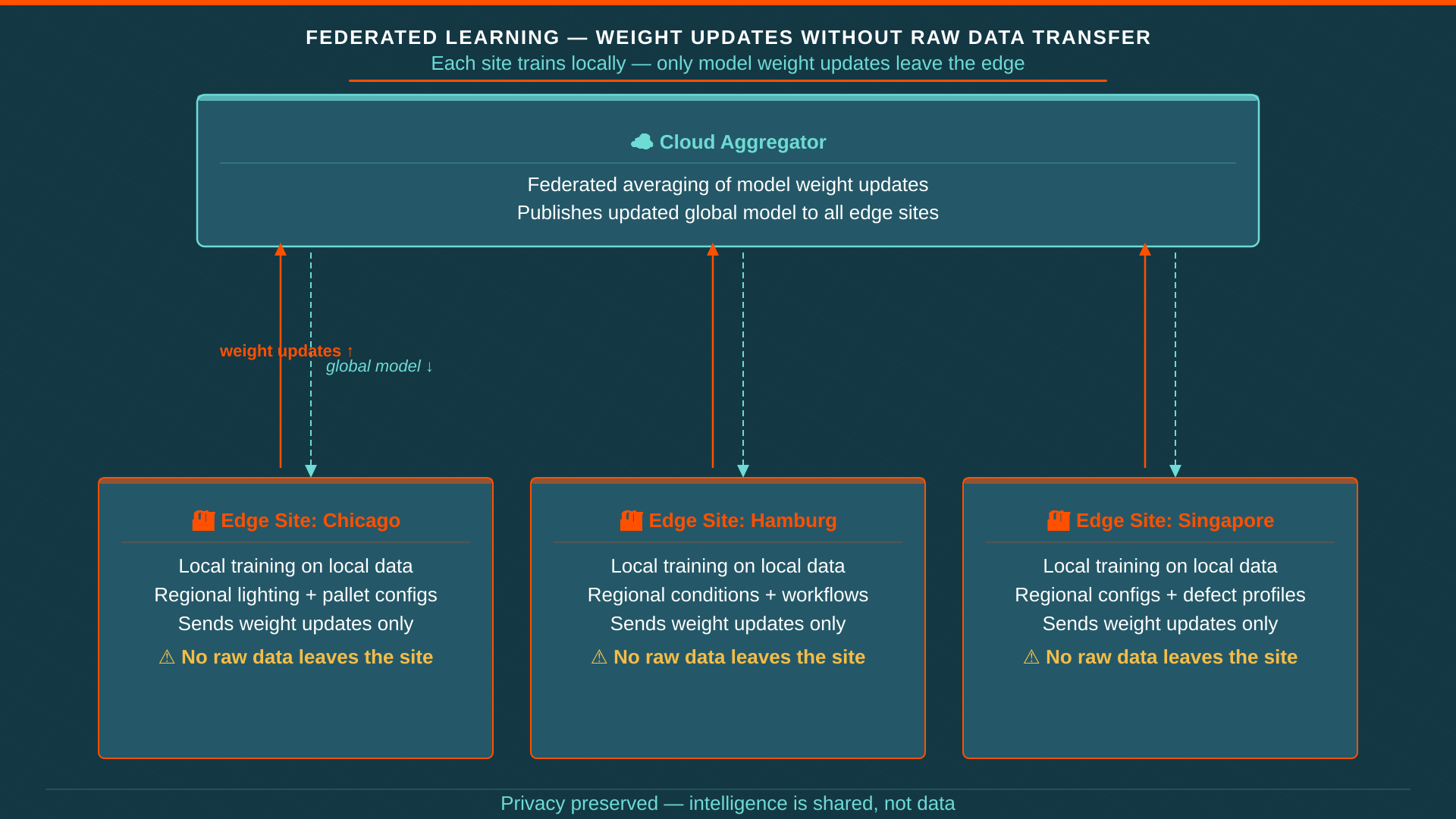
Figure 7: Federated learning across three edge sites: only weight updates travel to the cloud aggregator, never raw data
The outcome after several federated rounds is significant. A defect type that is rare at any single site, appearing perhaps 12 times in Chicago’s local dataset, may appear 200 times across the fleet. The global model trained on aggregated weight updates learns to recognize it robustly, and every agent in the fleet benefits without any site compromising data sovereignty or violating local data residency requirements.
Guardrails: Building Trust in Autonomous Agent Networks
The more autonomy an agent system is granted, the more rigorously its safety architecture must be designed. Guardrails are not an optional layer added after deployment. They are the foundational mechanism by which organizations earn the confidence to expand agent autonomy over time.
In a well-designed agentic platform, guardrails operate at multiple levels simultaneously. At the action level, every proposed agent action is validated against a defined ruleset before execution. At the confidence level, actions whose model confidence falls below a defined threshold are automatically escalated to a human rather than executed. At the rate level, agents are subject to cooldown periods to prevent runaway feedback loops. At the audit level, every action, whether permitted, blocked, or escalated, is written to an immutable log that cannot be modified after the fact.
Guardrails are not constraints that limit what an agent can do. They are the mechanism that makes stakeholders willing to grant agents meaningful autonomy in the first place. Without them, no organization will authorize consequential autonomous action.
A Complete End-to-End Flow: The Factory in Action
Take a paint defect appearing on a vehicle body partway through the assembly process. Here is how the agent network responds, step by step:
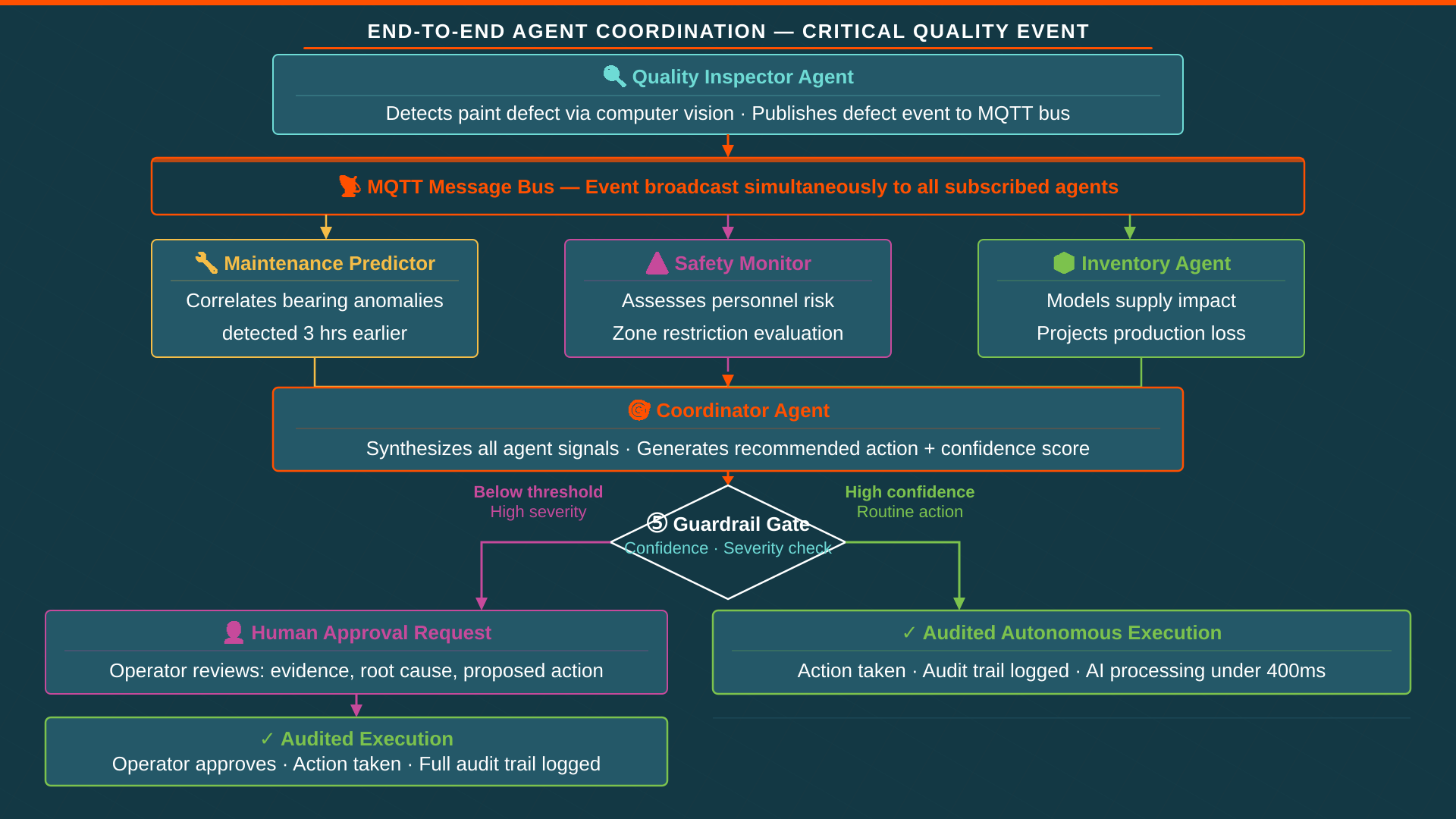
Figure 8: End-to-end agent coordination flow for a critical quality event, from detection to audited action
The AI processing portion of this sequence completes in under 400 milliseconds. The human approval step at the guardrail gate is the intentional variable. Critically, by the time the approval request reaches the operator, the agent network has already completed the hard analytical work: it has identified the probable root cause, correlated it against historical precedents from shared memory, and prepared a complete response plan. The operator is not being asked to diagnose the problem. They are being asked to authorize a specific, evidence-backed solution.
Why “AI Factory” Is the Right Metaphor
The term “AI factory” earns its name. A factory, in the operational sense, is a system of specialized roles working in coordinated sequence under shared protocols, with quality control built into every stage. A mature multi-agent AI deployment is structurally identical.
The worker analogy extends further than it might initially seem. A skilled machinist does not need to know how to run the paint booth, but she does need the paint booth operator to communicate when a delay is coming. An inspector does not stop the entire line every time he sees a minor surface scuff, but he does have the authority and the protocol to do so when a defect is critical enough. These are agent behaviors. These are orchestration patterns. Industrial operations have refined these coordination mechanisms over more than a century. The engineering task now is encoding them into software agents that can execute them at machine speed.
The next-gen AI factory is not a single superintelligent model watching everything. It is a network of purposeful, specialized, communicating agents, each excellent at one thing, collectively capable of things no single agent could accomplish alone.
Getting There: Practical Architecture Principles
Design agents around operational domains, not data streams. Resist the temptation to split agents along technical boundaries (camera feeds, sensor streams). Align them instead to operational domains: Quality, Safety, Maintenance, Inventory. Domain-aligned agents map cleanly to organizational roles and are far easier to govern, audit, and explain to non-technical stakeholders.
Make the message bus the integration layer, not the API. Point-to-point API calls between agents create coupling that makes the system brittle and difficult to evolve. An event-driven pub/sub architecture, where agents publish to topics and subscribe independently, allows the mesh to grow without modifying existing components. New agents can join without touching any existing agent code.
Treat shared memory as infrastructure, not an afterthought. Teams frequently deploy agent systems without a shared memory layer, only to discover later that there is no mechanism for agents to learn from past events. Building even a minimal episodic store and a vector database from day one fundamentally changes the system’s long-term trajectory and enables cross-agent reasoning that is otherwise impossible.
Build the guardrail framework before expanding autonomy. Guardrails are significantly harder to retrofit into a running system than to design in from the beginning. Before authorizing agents to take consequential actions, define explicitly which action classes require human approval, which require logging only, and which are fully autonomous. This is a governance exercise as much as a technical one.
Instrument for observability from the first deployment. A multi-agent system that cannot be observed cannot be debugged, improved, or trusted for expansion. Every agent should emit structured telemetry from day one. Build dashboards. Define alert thresholds. Establish a clear baseline for normal behavior before something goes wrong in production.
Where This Is Heading
The shift from isolated model deployments to collaborative agent orchestration is a structural change in how AI systems are built for complex, real-world environments. The problems that matter most in industrial AI, safety, quality, maintenance, coordination, are inherently multi-dimensional, time-extended, and cross-domain. A single inference pipeline was never architected to handle them.
Multi-agent systems address this by bringing specialization, shared memory, event-driven communication, and continuous learning together into a coherent operational layer. They are harder to build than a single model deployment. They require deliberate design of communication topology, memory architecture, guardrail frameworks, and observability infrastructure. The payoff is a system that genuinely learns, adapts, coordinates, and acts at a level of operational sophistication that isolated model deployments simply cannot reach.
The next-gen AI factory is not a black box. It is a team. And like any high-performing team, it works best when each member is excellent at a specific role, communicates state clearly, and operates within a shared framework of rules and accountability. The engineering challenge is building that team, one well-designed agent at a time.