
Security
Secure Edge Orchestration, Without Compromise
Edge Security Risks You Can’t Ignore
Edge environments expose infrastructure to security risks that traditional IT and data center tools were never designed to address:
Lack of Physical Perimeter
Edge devices often operate in unsecured locations without onsite security or physical isolation, making them vulnerable to theft, tampering, disk cloning, or malware injection via USB or other physical interfaces.
Perimeter-Less Networks
Traditional firewalls and intrusion detection systems may not exist at remote sites, significantly expanding the attack surface.
Connectivity Challenges
Intermittent, low-bandwidth, or air-gapped environments complicate security management from OS to application, including security patching to mitigate critical vulnerabilities and exposures (CVEs).
Vulnerability Explosion
Thousands of geographically distributed nodes, often using heterogeneous hardware and software, increase exposure to CVEs, configuration drift, and coordinated cyberattacks.
Secure by Design, from Factory to Fleet
ZEDEDA incorporates Zero Trust principles throughout its architecture to protect edge devices without a security perimeter. Every device access, interaction, and workload is continuously verified and requires explicit operator input.
To support this approach at scale, trust must be established before deployment and maintained throughout the edge lifecycle. Key elements include:
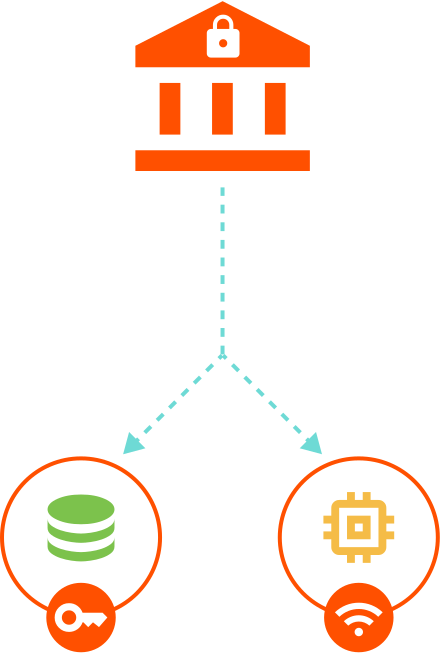
Built-In Zero Trust Architecture
Device identity rooted in hardware Trusted Platform Modules (TPMs), remote attestation, policy-based access controls, per-application firewalls, default-deny networking, and disabled physical ports enforce least-privilege access by default.
Immutable Software Stacks
Measured boot, cryptographic identities for each device component, and remote attestation ensure that only trusted firmware and software run on edge devices.
Resilient Offline Operations
In disconnected or air-gapped environments, ZEDEDA maintains secure local control and synchronizes safely with the cloud when connectivity is restored to download security-related software updates.
Security Philosophy and Core Principles
Security is an integral part of ZEDEDA’s edge orchestration platform. The platform follows a Zero Trust model that never assumes devices, users, or networks are inherently safe. By default, edge nodes can only be accessed via an API, not direct login, and every API interaction requires authentication.
This approach is designed to address the realities of edge computing, including physical access to devices, the absence of traditional network perimeters, limited on-site IT expertise, and long-lived deployments that must remain secure over time.
The following principles guide how security is implemented across the platform:
Full-stack Cryptographic Validation
To prevent rogue devices from running in your edge environment, ZEDEDA gathers the cryptographic identities of every component of edge devices – BIOS, firmware, operating system, VMs, containers, and applications and workloads – then checks for anomalies that suggest device tampering, including malware or ransomware injection.
Strong Isolation
Each application and workload runs in its own virtual machine or container, with per-application firewall rules that enforce isolation, prevent lateral data movement, and limit the blast radius of a security breach, ensuring that a compromise in one application does not affect others.
Defense in Depth
Multiple layers of protection and continuous visibility help mitigate evolving security threats.
Secure Patching
Signed configurations and images, hardware root of trust, measured boot, and remote attestation ensure updates do not become attack vectors.
Key Components of ZEDEDA’s Security Architecture
ZEDEDA’s security architecture is built into the platform and spans two tightly integrated components: EVE-OS and ZEDEDA Edge Infrastructure Services.
Hardware Root of Trust
- TPM chips generate and store private keys that never leave the TPM
- Prevents device or disk spoofing
- Secures additional keys for application stacks
Firmware and Software Integrity
- Measured boot and remote attestation on device startup
- TPM detects unauthorized changes to BIOS, firmware, boot-loader, OS, VMs, containers, and applications
- Unapproved changes trigger rollback to a trusted version
- All volumes, credentials and secrets are encrypted, and decrypted only after successful TPM-based verification
Networking and I/O Connectivity
- Default-deny firewall and I/O rules per application
- Physical network and I/O ports are disabled by default, preventing device flashing.
- Direct attachment of I/O devices to applications and workloads
- Support for air-gap networks and isolated VPC-like environments
Encrypted Data Store
- All sensitive data encrypted at rest
- Credentials encrypted using ZEDEDA Cloud vault services
- Decrypted data exists only in memory
- Virtual TPM (vTPM 2.0) extends trust to guest applications
Layered Security Model
- Cryptographic signatures protect content integrity
- Security maintained even in environments with TLS-inspecting proxies
Minimal Attack Service
- API-only access to EVE-OS that exposes only minimal functionality to manage edge devices
- No on-device user accounts or logins
- No ssh by default
EVE-OS Security Architecture
EVE-OS is an open-source, vendor-agnostic, Linux-based edge operating system curated by LF Edge. It provides the foundational security layer that supports ZEDEDA’s edge orchestration capabilities.
Data Protection
- TLS for all communications between EVE-OS and ZEDEDA Cloud
- Encryption at rest for all customer metadata
- Data volumes decrypted only after measured boot completes successfully
- Secure vault for key and secret management
Secure Processes & DevSecOps
- Static and dynamic code analysis in CI/CD pipelines
- Secure API gateway with authorization enforcement
Application Security
- Fine-grained Role-Based Access Control (RBAC) and least-privilege access
- Identity Management (IdM) integration using OAuth and OIDC
- Support for Microsoft Entra ID (formerly Azure AD), Okta, and Google Workspace.
- Comprehensive audit logging
- SIEM integrations for compliance and monitoring
Infrastructure Security
- Runs within secure VPC environments
- Continuous vulnerability monitoring and patching
- Web Application Firewall (WAF)
- Regular penetration testing exceeding OWASP Top 10 standards
Security Certifications
- ISO-27001:2022
- SOC-2 Type 2
ZEDEDA Cloud Controller Security
The ZEDEDA console is a multi-tenant, scalable SaaS controller that enables secure orchestration and management of distributed edge environments.
What Makes ZEDEDA’s Security Approach Unique?
Securing the edge requires more than applying traditional security controls to distributed infrastructure. ZEDEDA’s approach differs by embedding security enforcement directly into edge orchestration, ensuring protection is consistent, scalable, and aligned with how edge environments actually operate.
Designed for the Distributed Edge
Addresses physical access risks, lack of onsite IT staff, and perimeter-less environments.
Zero Trust Integrated by Design
Hardware-rooted identity, pervasive isolation, and continuous verification of all EVE-OS API calls are part of the platform, not add-ons.
Open Source Foundation (EVE-OS)
Code is available for any security expert to inspect and patch any security flaws.
Operational Simplicity
Secure Zero Touch onboarding and lifecycle management, no onsite IT staff required. Edge devices securely boot up, phone home, and configure themselves.
Long-Term Resilience
Secure patching and visibility for long-lived edge deployments.
Comprehensive Orchestration
Security, visibility, and control unified in a single edge orchestration platform.
Ecosystem Integration
Supports OT security tools, virtual firewalls, and complementary controls.