For decades, industrial field operations have run on instinct, experience, and scheduled maintenance windows. Equipment runs until it doesn’t. Data gets collected and reviewed hours or days after the moment it would have been useful. The people closest to the machines often have the least access to the information that would help them do their jobs better.
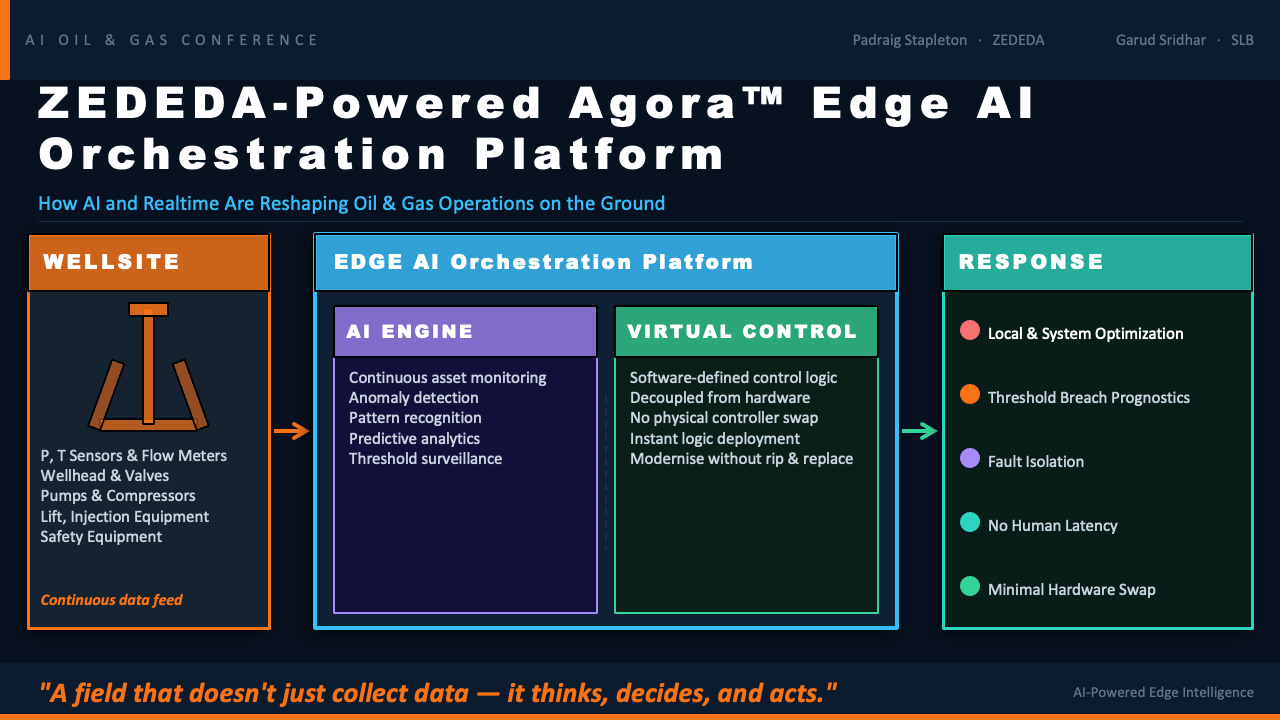
The technology to change that is no longer the obstacle. The harder questions are how you deploy AI in environments that are hazardous, built on decades of legacy infrastructure, and governed by safety rules that exist for good reasons. Recently at the AI in Oil and Gas Conference in Houston, Texas, ZEDEDA CTO Padraig Stapleton sat down with Garud Sridhar, Head of Product for Intelligent Operations at SLB, to explore exactly that. Watch the full conversation below, and read on for the discussion highlights.
The Trust Curve Is a Staircase, Not a Cliff
Consider commercial aviation. Tens of thousands of aircraft are in the air right now, each carrying hundreds of passengers who give no thought to the autopilot managing altitude, airspeed, and fuel burn in the background. That trust is well-founded. But it was built incrementally over decades: first hold the wings steady, then manage altitude, then automate the approach, then full instrument landing in zero visibility. Each stage earned trust before the next was attempted.
Industrial operations are on the same curve. The destination is not in question. Automated systems will handle more of the routine, time-sensitive decisions that currently require a person to be physically present. The question is where you are on the staircase, and what the next step looks like from where you stand.
AI adoption in industrial settings is not a replacement for human judgment. It is a gradual handoff, governed by evidence, that only works when the people depending on it trust what the system is doing and why. Skipping steps does not accelerate the journey. It undermines it.
The People the Dashboards Forgot
Most early AI deployments in industry served the people in the operations center, not the people doing the work.
Fifty to sixty percent of operations personnel are out in the field making adjustments to equipment, responding to anomalies, running physical inspections. They have the highest need for better information and have historically been the last to receive it.
The real transformation is not better dashboards for people who are already well-informed. It is putting actionable intelligence in the hands of field workers, in context, at the moment they need it. A flood of alerts that requires a technician to triage 50 notifications before doing anything useful is not actionable intelligence. It is noise, and people learn to ignore noise quickly. Once that credibility is lost, it is very hard to rebuild.
What actionable looks like in practice, including real cases where getting it right changed the outcome of an operation, is something you can hear directly in the video above.
Safety Is Non-Negotiable. That Is Actually the Point
The concern that AI might make decisions in environments where mistakes can kill people is legitimate and worth taking seriously. The answer is not to avoid AI in operations. It is to understand what the safety architecture actually looks like.
In industrial operations, the safety layer sits at the base of the stack and nothing touches it. If a high-high signal triggers or a pressure sensor detects a dangerous condition, the system shuts down. That logic is hardwired, certified, and inspected. No AI model has access to it. No optimization algorithm can override it.
Above that inviolable floor, there is significant room for advanced process controls, operational optimization, and AI-driven decision support. The safety layer is not a constraint on what you can do above it. It is what makes it safe to push harder on the layers above. Treating safety, process control, and business intelligence as distinct layers with different requirements and different risk tolerances is what makes AI adoption tractable in this environment. Conflating them is what makes it feel impossible.
Why AI Projects Fail in the Field
Why AI Projects Fail in the Field Models that perform well in a controlled environment frequently behave very differently once deployed in the field. Field data is messy. The frequency, quality, and characteristics of sensor data in a remote industrial environment look nothing like the historical data a model was trained on. Sensors drift. Connections drop. Environmental conditions introduce noise that was not in the training set.
The symptom is alert fatigue. When a model generates too many false positives, operators stop trusting the alerts. Once credibility is gone, the alerts that actually matter get ignored along with the ones that do not.
The root cause is almost always the insight-to-action gap: a technically accurate output that does not connect to anything an operator can do with it right now. The gap between “something is anomalous” and “here is what you should do in the next 15 minutes” is where most industrial AI projects fail. Better models do not solve bad data pipelines. Field validation is not optional. And the feedback loop between field operators and the teams building the models is the mechanism by which those models learn what the field actually looks like.
The Governance Gap Nobody Talks About
Industrial operations have a well-established discipline called Management of Change (MOC): before any significant change is made to an operational system, there is a formal process for evaluating risk, documenting the change, getting approvals, and validating the outcome. MOC exists because a poorly executed change can injure workers or destroy expensive equipment.
MOC was designed for a world where changes happen slowly. A hardware modification. A configuration change that takes weeks of planning and a scheduled maintenance window. AI model updates do not work that way. They can happen continuously, automatically, and with minimal human visibility. A model that was performing well last week may have been retrained since then. The system’s behavior has changed, but no MOC process captured it because the process was not designed for this pace.
The industry needs an MOC framework specifically adapted for AI: one that accounts for the speed and frequency of software change without abandoning the rigor that makes MOC valuable. This is one of the most under addressed governance gaps in industrial AI today, and it is one of the most consequential. The video above includes a deeper discussion of what that framework could look like in practice.
The Goal Is Not to Remove Humans. It Is to Elevate Them
Most industrial operations are not ready for fully autonomous AI decision-making, and they should not be. Trust has not been sufficiently established. MOC processes have not been adapted. Security architectures have not been proven at scale. Skipping ahead to full autonomy before those foundations are in place is not boldness. It is a setup for failure that sets back the broader adoption of these technologies.
The more useful framework is risk-tiered autonomy. In low-risk, bounded scenarios where the consequence of a mistake is small and reversible, greater autonomy is appropriate. In safety-critical decisions with potentially fatal consequences, a human must remain in the loop. You start where the risk is manageable, demonstrate value, build trust, and expand from there.
The goal is not to remove people from operations. It is to free field technicians from reactive firefighting, from manual data collection, from chasing alerts that turn out to be nothing, so they can focus on the decisions that genuinely require their judgment and experience. Pilots still fly planes. They just fly them better, safer, and with far more information than they had 50 years ago. That is the model for where industrial AI is headed.
Watch the full conversation above for a deeper discussion of deployment architectures, security for unattended edge devices, and real-world lessons from the field. And if any of these challenges resonate with what your organization is working through, we would welcome the conversation.