
ZEDEDA Architecture and Core Platform
The ZEDEDA Edge Intelligence Platform manages the full lifecycle of edge intelligence deployments, from device onboarding to AI workload orchestration and ongoing operations. It automatically reduces the complexity associated with matching AI models to the right inference engines and running them across a wide variety of edge AI hardware.
The platform establishes a consistent operational model across diverse edge hardware, allowing infrastructure, applications, models, and agents to be deployed and managed through a centralized control plane.
ZEDEDA connects to edge nodes running EVE-OS through a secure, outbound-only model—eliminating inbound ports and enforcing a Zero Trust posture by design.
The architecture is built to:
- Operate across heterogeneous edge hardware, from lightweight gateways to GPU-enabled systems
- Support edge intelligence workloads under real-world constraints, including limited bandwidth and intermittent connectivity
- Scale from initial deployments to large, distributed fleets using the same workflows
- Enforce Zero Trust across devices, workloads, and communication paths

ZEDEDA Edge Intelligence Platform
The centralized control plane for deploying, managing, and securing edge intelligence at scale.
It governs access, enforces policy, and manages lifecycle operations across distributed edge clusters at global scale, with integrated edge-native services for updates, access control, and workload lifecycle management, including the inference engines, AI models, infrastructure services and AI agents that bring native MLOps and GitOps practices to the edge.

EVE-OS
A secure, open-source edge operating system purpose-built for edge intelligence.
It abstracts hardware complexity and provides a trusted foundation for running containers and virtual machines side by side on any edge device, with strong isolation, hardware-rooted identity, and no local user access. EVE-OS is supported on a wide range of hardware platforms, including x86 and ARM architectures. It comes with drivers and SDK support for a wide range of edge AI hardware accelerators to deliver the best in breed AI model inference performance.

ZEDEDA Edge Marketplace
A curated ecosystem of hardware vendors, infrastructure software partners, AI model providers, agent framework providers, edge AI silicon partners, edge intelligence solution partners and AI observability providers.
It enables interoperable, production-ready deployments without fragmentation or vendor lock-in.
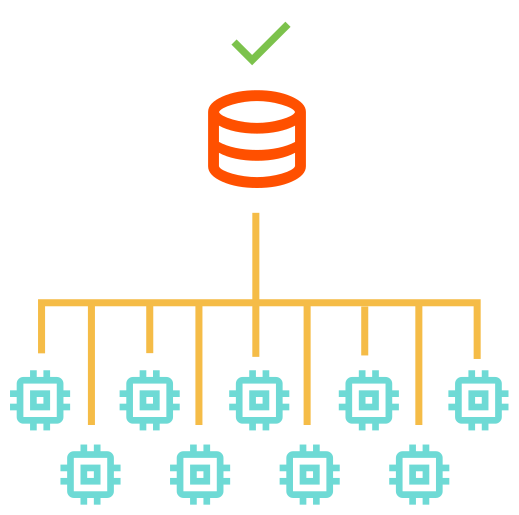
Models must be validated on real edge hardware before deployment. Performance in cloud environments does not reflect real-world edge conditions.
How it works:
- Configure an External Provider to connect to NVIDIA NGC, Hugging Face, Qualcomm AI Hub, AWS S3 and SageMaker, Azure ML and Azure Blob Storage, MLflow, or upload locally from your ML notebooks or local file system.
- Browse & Select Model to identify the correct model and version from an external catalog.
- Import the Model by triggering an async import job into your organization’s centralized catalog.
- Monitor Import until the model is available for benchmarking and deployment.
- Add Device to Pool (Admin) to define the target hardware used for evaluation, such as jetson-agx-orin or intel-nuc.
- Create Benchmark by selecting model(s), device type(s), and test parameters such as duration, concurrency, and batch size.
- Run & Analyze benchmark results for latency, throughput, and resource utilization across hardware profiles.
This gives teams a way to validate model behavior on actual edge infrastructure before moving into production.
Platform defaults for inference:
- x86_64 CPUs → OpenVINO inference server for ONNX models and vLLM for GenAI models
- Jetson/arm64 → Triton inference server for ONNX models and vLLM for GenAI models
- Qualcomm IQ9 - Triton Inference Server for ONNX models and GENIE for GenAI
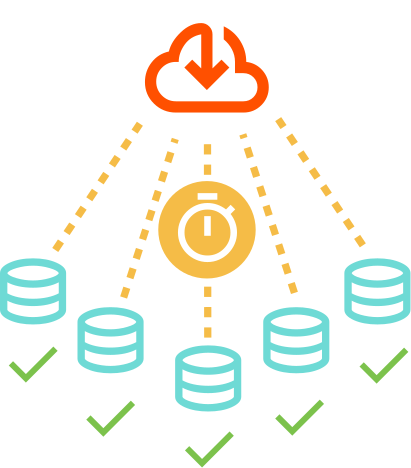
ZEDEDA enables direct deployment of models to edge environments without manual infrastructure setup.
How it works:
- Select Model from your organization’s model catalog
- Pick Target Cluster by choosing an available ZEDEDA Edge Kubernetes Service cluster (or cluster group)
- Create Deployment Submission using one-click deployment directly from the model page
The platform then:
- Auto-generates a Helm chart with the appropriate inference engine, for example, OpenVINO for x86, or Triton Inference Server for Jetson
- Includes a demo business app by default (zededa/edgeai-demo-app:latest), which can be customized
- Deploys via a GitOps workflow with full audit trail
- Exposes REST endpoints for immediate integration and testing
Result: The model is live on the edge within minutes, exposing highly performant REST endpoints for inference and paired by default with the ZEDEDA on-device eval agent as the business application to guide the user for quick evaluation of the model
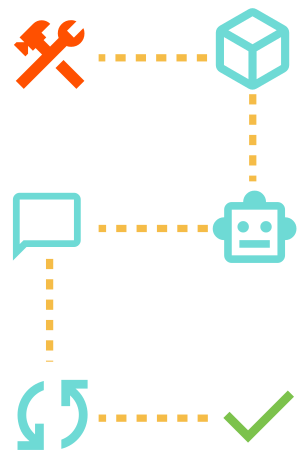
Edge intelligence requires coordinated execution of models, runtime environments, and application logic.
How it works:
- Select Base Model – Choose the model to package into a solution
- Configure Solution – Use the conversational builder to define platform, inference server, resource limits, and optionally a custom business app image
- Generate Helm Chart – Let the system create a complete, production-ready deployment package
- Upload as Solution Blueprint – Publish the package into the Solution Catalog with versioning and tags
- Deploy Solution – Use the custom_solution submission type referencing the solution_id (and optional chart_version) to deploy
What’s different: Agentic Solutions bundle model, runtime, business logic, and configuration into a reusable, version-controlled package. They enable complex multi-model pipelines, custom preprocessing, and domain-specific deployments.
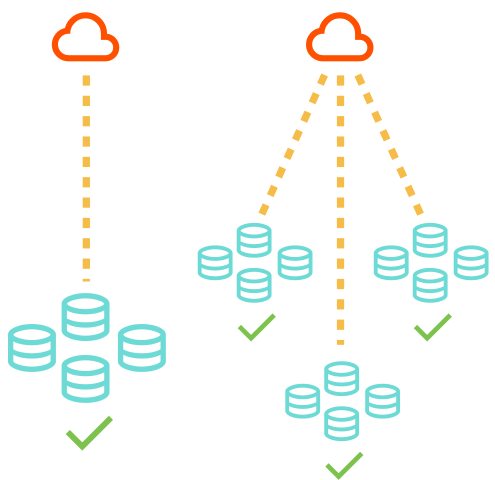
Scaling edge intelligence requires consistent deployment, governance, and visibility across distributed systems.
How it works:
- Find Solution – Browse Solution Catalogs for pre-built blueprints
- Select Target – Choose a single cluster or a cluster group for multi-cluster deployment
- Create Deployment Submission – Use custom_solution with:
- solution_id and optional chart_version
- target_type='CLUSTER' or 'CLUSTER_GROUP'
- target_value equal to the cluster name or group name
- Wait for Review – Allow an administrator to review and approve the deployment where required
- Monitor – Use the GitOps workflow to ensure consistent rollout and track deployment state across all targeted clusters
Deployment Stages:
- Development: Quick deploy to a single cluster, perform a quick evaluation
- Staging: Benchmark on real hardware, validate latency and accuracy
- Production: Use the GitOps workflow with canary rollout to a cluster group, monitor behavior, then expand to the full fleet
These mechanics allow teams to move from pilot to production while maintaining governance, safety, and repeatability across the edge fleet.
Automation with APIs
ZEDEDA integrates into existing enterprise workflows through APIs and infrastructure-as-code support.
For advanced workflows, ZEDEDA supports Terraform and northbound APIs to automate the full lifecycle of edge intelligence, from provisioning to deployment and operations, while integrating with CI/CD systems, application controllers, orchestration platforms, and cloud environments.
Use cases include:
- Infrastructure and workload automation using Terraform
- Integration with cloud services for data pipelines and edge-to-cloud workflows
- SD-WAN and firewall integrations for secure connectivity
- Kubernetes ecosystem integrations for portable, cloud-native workload orchestration at the edge
- Custom lifecycle workflows built through northbound API integration with existing enterprise systems